

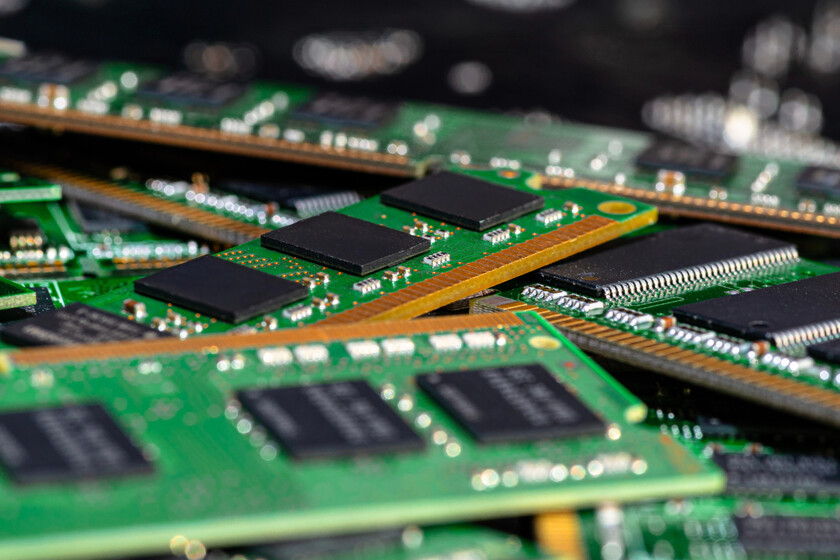
In recent years, the global technology industry has undergone a profound transformation, driven by technological advancements and the exponential growth of sectors such as artificial intelligence, big data, and automation. In this scenario, a small-scale electronic component of great strategic importance has gained prominence: NAND memory chips. These components, responsible for data storage in electronic devices, have become the focus of a true appreciation race and financial speculation in China, one of the world’s largest technology hubs.
The global increase in demand for storage semiconductors, especially due to the explosion in the use of artificial intelligence and related technologies, has drastically elevated the value of these chips. This demand, coupled with supply shortages, has created a highly volatile market where Chinese traders have begun acting as investors, buying and stockpiling chips in anticipation of rapid appreciation. The result has been a growing appreciation of these components, which are now frequently compared by analysts and investors to gold or oil, due to their potential to generate extraordinary short-term profits.
Market Context of NAND Chips in China
In China, NAND memory chip production is highly concentrated, with major factories controlled by companies such as Samsung, SK Hynix, Micron, along with local manufacturers seeking to expand their market share. However, global production cannot meet the increasing demand caused by the expansion of sectors like artificial intelligence, cloud computing, and industrial automation. As a consequence, the supply of memory chips has fallen short, leading to shortages that drive prices exponentially higher.
The Chinese market, in particular, stands out for its aggressive response to this shortage. Local traders, who often act as digital asset investors, have begun acquiring large volumes of chips, anticipating price increases and profiting from subsequent sales. This buy-and-sell strategy, previously typical of traditional financial markets, has also become a common practice in the tech sector, fueled by a combination of speculation, expectations of appreciation, and strategic stockpiling policies.
The Role of NAND Memory Chips in the Artificial Intelligence Era
To understand the magnitude of this trend, it is essential to grasp the role of NAND memory chips in current technological infrastructure. These components form the backbone of data storage in modern devices, including smartphones, servers, data centers, and autonomous vehicles. Their importance goes beyond simply storing personal files, extending to supporting the operation of advanced artificial intelligence models.
Essentially, NAND memory chips enable the efficient storage of massive volumes of information, which is indispensable for AI systems that rely on quick data access during training and execution of complex tasks. Without these components, processing Big Data, facial recognition, natural language processing, and other high-complexity applications would not be feasible at modern scales. As a result, demand for these chips has increased exponentially, prompting manufacturers to adjust their production lines to meet this new reality.
Applications and Impacts of NAND Chip Demand
- Data centers: use storage units based on NAND chips to support the processing of high-complexity AI models
- Smartphones and mobile devices: depend on these chips for storing applications, photos, videos, and essential data for system operation
- Autonomous and electronic vehicles: utilize memory chips for storing sensor data, maps, and navigation algorithms
In all these sectors, the need for high-capacity and quick-access storage makes NAND chips essential. As a result, their demand has surpassed supply, creating price pressures that favor speculative strategies and large-scale purchasing movements, especially in China, where traders’ activities are evolving into a true financial market scale.
Speculation and Profits in China: How Traders Exploit Shortages
Since early 2025, the NAND memory chip market in China has entered a phase of intense speculation. With clear signs of shortages and rising production costs, local investors and traders have begun acting similarly to commodity traders, acquiring large batches of chips in anticipation of price adjustments. This strategy, which has generated millionaire profits in just a few months, is based on the expectation of rapid and continuous asset appreciation.
Practically, these traders operate on a logic of intensified buying before new price hikes and subsequent selling at peak moments, profiting from the difference. This practice, driven by news of supply chain difficulties, production limitations, and international trade restrictions, has been facilitated by easy access to e-commerce platforms and digital asset trading in China.
Market Dynamics of Chips in China
- Preemptive buying: traders acquire chips in large quantities as soon as signs of shortages appear
- Strategic stockpiling: keep chips in inventories, waiting for future appreciation
- Selling at peaks: when prices rise, they execute quick sales to realize substantial profits
This dynamic, combined with strong speculation, has caused daily price fluctuations, sometimes with nearly instant adjustments. In some cases, profits made by Chinese investors multiply their investments several times within a few months, fueling a cycle of appreciation that, in turn, further drives demand and speculation.
Impacts on the Global Semiconductor Market
The increasing appreciation of NAND memory chips in China reverberates throughout the global semiconductor market, influencing prices, supply chains, and production strategies. Multinational technology companies, component manufacturers, and governments are closely monitoring the changes caused by this speculative movement, which could alter the balance of supply and demand worldwide.
On one hand, chip manufacturers face the challenge of expanding their production to meet rising demand, while on the other, the financial market observes potential opportunities for quick profits. The volatility characterizing this market can, on one side, stimulate investments but also pose risks of instability that could affect the entire technology supply chain.
Market Outlook and Challenges for NAND Chips
- Investments in production capacity: companies are expanding their factories to meet demand
- Risks of speculative bubbles: rapid appreciation could lead to price instability in the medium term
- Supply chain impact: potential bottlenecks may affect sectors dependent on semiconductors, such as automotive, electronics, and telecommunications
Experts warn that, while there is potential for significant profits, volatility and speculation also pose considerable risks. The trend of rising prices may stabilize or even reverse if global production manages to respond more efficiently to market needs. Nonetheless, the current dynamics highlight the growing strategic importance of NAND memory chips in the global digital economy.